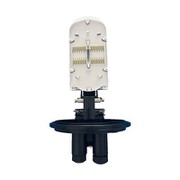
The function and connection method of pigtail type optical fiber terminal box
May 20, 2023
Optical fiber communication has many advantages such as wide transmission frequency bandwidth, large communication capacity, and low loss, and is widely used in a wide range of fields. When light is transmitted in the optical fiber, it will generate loss, which is mainly composed of the transmission loss of the optical fiber itself and the fusion loss of the splicing point. Once the optical cable is ordered, the transmission loss of the optical fiber itself is basically determined, while the fusion loss at the optical fiber joint is related to the optical fiber itself and on-site construction.
In network cabling, fiber optic cables are usually used outdoors (connection between buildings), and Ethernet twisted pair cables are used indoors (inside buildings).
Step 1: The outdoor optical cable is connected to the terminal box, the purpose is to fuse the optical fiber and the pigtail in the optical cable, and lead it out through the jumper.
Step 2: Connect the fiber optic jumper to the fiber optic transceiver, the purpose is to convert the optical signal into an electrical signal.
Step 3: The fiber optic transceiver leads to electrical signals, and the transmission medium used is twisted pair. At this time, the twisted pair can be connected to the RJ-45 port of the network device. So far, the photoelectric signal conversion has been completed.
Note: Many network devices now have optical ports (optical fiber interfaces), but if there is no optical distribution module (similar to the function of optical fiber transceivers), this port cannot be used. The function of the optical cable terminal box: to terminate the optical cable and connect the core and pigtail in the optical cable.
Pigtail: There is a connector at one end and a broken end of an optical fiber core at the other end. It is connected to other optical fiber cores by fusion splicing. It is used in the terminal box to connect the optical fiber in the optical cable, and connect the pigtail and jumper through the terminal box coupler (adapter). The role is to connect the connectors at both ends of the optical fiber. One end of the pigtail is fused to the optical fiber connector, and the other end is connected to the optical fiber transceiver or optical fiber module through a special connector to form an optical data transmission path. Generally, we can't buy pure pigtails, but jumpers as shown in the figure, fiber optic transceivers or fiber optic modules are connected to form an optical data transmission path. Generally, we can't buy pure pigtails, but jumpers as shown in the picture.
Jumper: Both ends of the jumper are movable connectors. Play the role of connecting pigtails and equipment. The optical cable terminal box is a box that protects the optical cable and the pigtail fusion at the terminal of the optical cable laying.
Optical fiber coupler: It is used for the active connection of two optical fibers or pigtails, commonly known as a flange.
Optical fiber terminal box: It is the terminal connector of an optical cable, one end of which is an optical cable, and the other end is a pigtail, which is equivalent to a device that splits an optical cable into a single optical fiber.
Fiber splice box: It is used to connect two optical cables into one long optical cable. They cannot be used interchangeably. The optical cable and the optical transceiver are connected through a fiber optic terminal box, that is, only pigtails can be plugged into the optical transceiver.